On November 22, 2025, the 10th Global Procurement and Supply Chain Thousand-Person Conference organized by Haizhi Online was successfully held at the Shanghai Xuhui West Bund International Convention and Exhibition Center. This conference was guided by the Shanghai Municipal Commission of Commerce and the People's Government of Xuhui District, Shanghai, jointly hosted by the Service Trade Innovation Development Guidance Fund and Haizhi Online, with Shanghai Caohejing Emerging Technology Development Zone Development General Company as the strategic cooperation unit. It also received support from the Shanghai Technology Innovation Center, the Shanghai Humanoid Robot Innovation Incubator, and the Shanghai Industrial Internet Association. The conference scale set a new record, becoming the largest annual conference in the platform's ten-year history in terms of participant numbers, future industry engagement, cross-border integration depth, and international coverage.
(She Ying, Founder and Chairperson of Haizhi Online)
Roundtable 1Competing on Problem-Solving Ability, Not PriceThis roundtable focused on how small and medium-sized factories can build new competitiveness in an uncertain market environment. Shang Lei, General Manager of the Supplier Business Division at Haizhi Online, served as the moderator. Four factory leaders shared their experiences on transitioning from "passively accepting orders" to "actively solving problems," winning customers with capabilities rather than price.Luo Jiaming, General Manager of Changzhou Zhemeng Mechanical Manufacturing Co., Ltd., shared the factory's transformation towards "small batch, multi-variety" from the perspective of a "second-generation factory owner." Faced with an extreme task of "22 types of parts, nearly a thousand pieces, delivered in 45 days," his factory once fell into chaos. Now, through role standardization, process visualization, and collaboration mechanisms, he has solidified firefighting experiences into long-term capabilities, making "assault teams" a basic skill of the factory. He believes that small batch, multi-variety production is not a burden but the best training ground for factories to establish new competitiveness.
(Luo Jiaming, General Manager of Changzhou Zhemeng Mechanical Manufacturing Co., Ltd.)
Li Liang, General Manager of Suzhou Medishine Photovoltaic Technology Co., Ltd., shared how his company managed to produce a highly complex component during their early startup phase—despite not having five-axis equipment—by breaking down the manufacturing process into seven or eight distinct operations. This successful delivery allowed them to secure a long-term partnership with a leading robotic vacuum cleaner enterprise. He emphasized that equipment alone does not determine a factory's ability to enter a new industry; rather, it is their strengths in process innovation, problem comprehension, and continuous improvement. By consistently upgrading their capabilities—from materials and wear resistance to fast-charging technology—in alignment with their client's innovation roadmap, they transformed from a standard supplier into a strategic partner deeply involved in product iteration.
(Li Liang, General Manager of Suzhou Medishine Photovoltaic Technology Co., Ltd.)
Zhou Hua, General Manager of Suzhou Xiangao Precision Machinery Co., Ltd., recalled the "darkest moment" in 2008: three out of four core clients saw an 80% drop in output value, nearly halting the factory. The crisis forced him to restructure capabilities. Through customer diversification, cross-industry layout, and early involvement in R&D and standard setting, he gradually built organizational resilience against fluctuations. Today, Suzhou Xiangao has accumulated over 100 high-quality clients, with more than 50 maintaining long-term cooperation.
(Zhou Hua, General Manager of Suzhou Xiangao Precision Machinery Co., Ltd.)
Li Bowei, General Manager of Dongguan Jichang Mold Co., Ltd., the youngest guest in this session, explained how he won over medical clients through "understanding value." Starting from the usage scenario, he extended the lifespan of a critical component from 2 days to 3 months—a 45-fold increase—through material upgrades, process optimization, and coating combinations. He emphasized that if you can truly save customers money and effort in comprehensive costs, you can gain technology and service premiums, as well as customer trust.
(Li Bowei, General Manager of Dongguan Jichang Mold Co., Ltd.)
In summary, Shang Lei, General Manager of the Supplier Business Division at Haizhi Online, stated that for small and medium-sized factories, the key to current manufacturing competition lies in three points: shifting from a "price mindset" focused on individual orders to a "problem-solving mindset" focused on building capabilities; upgrading from mere "executors" who work according to drawings to "customer partners" involved in R&D and jointly optimizing solutions; and moving from "relying on luck" for immediate opportunities to "securing long-term positions" based on niche tracks, core clients, and one's own strengths.
(Shang Lei, General Manager of the Supplier Business Division at Haizhi Online)
Roundtable 2Bipedal Awakening, Quadruped Evolution: Supply Chain Transformations in the Robotics TrackThis roundtable delved into the development trends within specialized segments of the robotics industry and the evolving supply chain demands. Chaired by Chang Qingqing, Director of the Procurement Business Division at Haizhi Online, the session featured insights from four experts representing collaborative robotic arms, autonomous mobile robots (AMRs), quadruped robots, and humanoid robots, who discussed product architectures and supply chain dynamics in their respective fields.Wu Chongyang, Global Intelligent Manufacturing Ecosystem Manager at Shenzhen Yuejiang Technology Co., Ltd., highlighted that collaborative robotic arms—a specialized niche within industrial robotics—are expanding beyond traditional material handling and machine tending tasks into new commercial applications such as coffee brewing and ice cream preparation. In the face of growing global competition, she stressed that companies must shift from simply selling hardware to delivering integrated solutions, building comprehensive scenario-based capabilities. Yuejiang is also extending its technology from robotic arms into full-body humanoids, semi-humanoids, and wheeled humanoid platforms, creating new growth opportunities for both the company and its supply chain partners in the emerging era of embodied intelligence.
(Wu Chongyang, Global Intelligent Manufacturing Ecosystem Manager at Shenzhen Yuejiang Technology Co., Ltd.)
Zhang Hongyuan, Global Category Manager for Intelligent Equipment at Beijing Geek+ Technology Co., Ltd., analyzed the mobile robotics track from an AMR perspective. He pointed out that as technical barriers lower and homogenization increases, "why choose you specifically" has become the core competitive point. Geek+ has established an Embodied Intelligence Business Unit, exploring the systemic value of "1+1>2" by combining mature chassis with semi-embodied/embodied forms. He emphasized that future supply chain competition requires not replication ability, but design and innovation capabilities—whether suppliers can collaborate with OEMs to achieve modular and systematic integration will determine their entry into the core supply chain of the embodied intelligence era.
(Zhang Hongyuan, Global Category Manager for Intelligent Equipment at Beijing Geek+ Technology Co., Ltd.)
Yin Chengxiang, Supply Chain Director at Magic Atom Robot Technology Co., Ltd., outlined three primary categories for robotic dogs: research and education, commercial inspection, and high-risk industrial applications. She emphasized that quadruped robots have evolved from "technology demonstrators" into practical "production tools." This segment demands complex structural components, tight precision tolerances, and undergoes extremely rapid iteration, which makes low-volume, high-mix production the standard. She highlighted that for any supplier, the ability to maintain high yield rates despite stringent precision and multi-fixturing requirements—coupled with competencies in rapid prototyping and manufacturability analysis—represents the critical threshold for not only entering this competitive field but also securing a sustainable position within its fast-paced ecosystem.
(Yin Chengxiang, Supply Chain Director at Magic Atom Robot Technology Co., Ltd.)
Yang Shaoping, Procurement Director at Humanoid Robot (Shanghai) Co., Ltd., provided a strategic analysis of the humanoid robotics sector from the vantage point of a national technology platform. He outlined its current primary applications in new commercial services, education and research, and large-scale data acquisition, noting significant long-term potential in industrial and elderly care settings. He candidly observed that the humanoid and bipedal segment has become intensely competitive even while still nascent. This environment, he stressed, demands that suppliers commit resources—in manpower, equipment, and process refinement—from the earliest R&D stages, possessing both the patience and resilience to navigate the journey from initial concept (0 to 1) to scaled commercialization (1 to 100).
(Yang Shaoping, Procurement Director at Humanoid Robot (Shanghai) Co., Ltd.)
In closing, Chang Qingqing, Director of the Procurement Business Division at Haizhi Online, concluded that in today's robotics sector—simultaneously hot and fiercely competitive—clients are no longer merely buying components; they are seeking valued partners who can act as an extension of their own R&D teams, solving complex problems collaboratively. A supplier's value is now determined by its technical prowess, process innovation, and long-cultivated expertise. In this fast-iterating industry, a supplier's delivery speed directly dictates the client's product velocity, and its responsiveness defines its strategic standing. The basis of competition has fundamentally shifted from a narrow focus on hardware to a broader contest of comprehensive capabilities and soft power.
(Chang Qingqing, Director of the Procurement Business Division at Haizhi Online)
Keynote SpeechNing Zhenbo, Independent Director of China State Shipbuilding Corporation Limited (7th and 8th terms), delivered a keynote speech. Drawing on fifty years of experience in aircraft overall design, he began with Adam Smith's "The Wealth of Nations" concept of "division of labor + exchange," reviewing the evolution of the modern industrial system: from self-sufficiency in agricultural societies to forming vast supply chains through division of labor in industrial societies; from the early industrial stage where companies like Dongfeng and Second Automotive Works had to "make everything themselves," to Boeing achieving global coordination through its "make-or-buy policy," and using the development of the Y-20 as an example, he demonstrated China's systematic breakthroughs in digitalization, collaborative manufacturing, and complex supply chain organization.Ning Zhenbo pointed out that global supply chain competition is entering a new phase based on digital collaboration. The evolution of Germany's Industry 4.0, the supply chain systems of Bosch and Toyota, and the global networks of Boeing and Airbus all point to the same trend: the core of a strong manufacturing nation is not individual enterprises, but the supply chain system composed of thousands of multi-tiered suppliers. Cases like Toyota and Nippon Steel in Japan illustrate that top-tier manufacturing must "protect the supply chain, build capabilities, and adhere to long-termism." He believes that Haizhi Online provides an era-valuable platform in promoting the digital collaboration of China's industrial chain and enabling more small and medium-sized factories to enter the global supply chain. China is at a critical window of once-in-a-century transformations; building a sustainable, collaborative, and visible supply chain ecosystem will become the core competitiveness of Chinese manufacturing in the next decade.
(Ning Zhenbo, Independent Director of China State Shipbuilding Corporation Limited, 7th and 8th terms)
Roundtable 3Soft Landing for Hard Tech: How New Species Move from Lab to ProductionThis roundtable focused on "how innovation lands," exploring the critical path for hard tech to move from the laboratory to mass production through the entire process: "source R&D, concept verification, small-batch manufacturing, industrialization." He Wei, Head of Research Institutions at the Haizhi Online Innovation Verification Research Institute, served as the moderator. Guests from incubators, universities, small-batch manufacturers, and Haizhi Online shared insights from different links of the innovation chain.Li Sihua, General Manager of Sinan Semiconductor Super Incubator, highlighted the inherent challenges in hard tech—particularly semiconductors—where high technical barriers and substantial capital investment are the norm. He observed that innovators, often hailing from academia or corporate R&D, typically lack the production expertise and supply chain connections necessary for industrialization. The core value of a high-quality incubator, he stated, is to bridge these critical gaps in talent, funding, and industry chain resources, enabling startups to concentrate on technological breakthroughs and prototyping. He expressed his expectation that collaboration with Haizhi Online will facilitate better access to manufacturing partners, thereby accelerating the path to mass production for more hard tech ventures.
(Li Sihua, General Manager of Sinan Semiconductor Super Incubator)
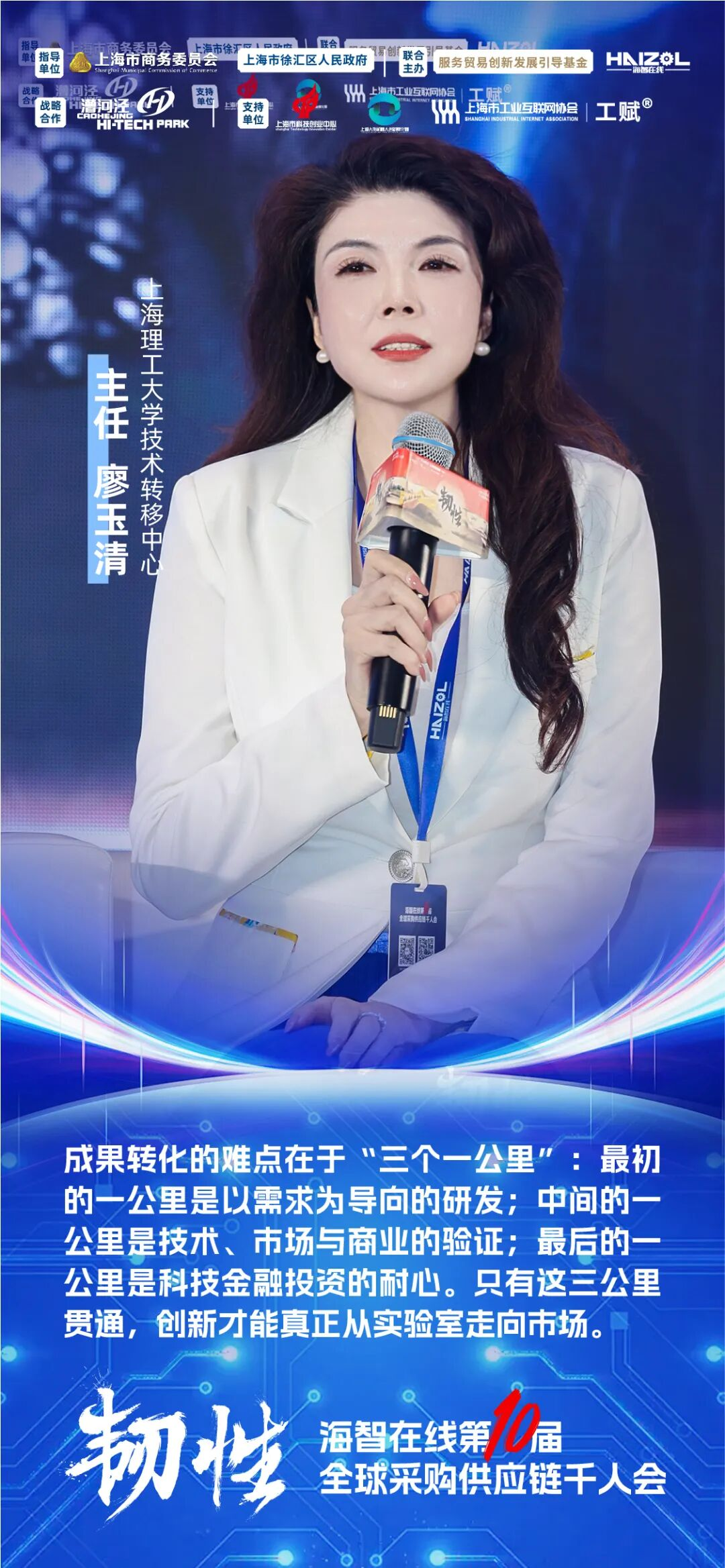
Liao Yuqing, Director of the Technology Transfer Center at Shanghai University, framed the challenges of university technology commercialization as a "three-stage relay race" where batons often get dropped. She explained that while academics excel at technological breakthrough, they often face gaps in product design and market development. This makes collaboration with manufacturing partners a critical link in the commercialization chain. Citing examples of new material and sensor projects, she illustrated how the Haizhi Online platform successfully connected university research with factories to define real-world applications. She believes that establishing stable "R&D—Verification—Application" collaboration among universities, platforms, and manufacturers is key to moving more lab innovations to the industrial front lines.
(Liao Yuqing, Director of the Technology Transfer Center at Shanghai University)
Jin Zhengpan, General Manager of Zhejiang Oudun Intelligent Manufacturing Technology Co., Ltd., traced his journey from operating a small prototype shop, asserting that innovation projects serve as the primary engine for factory growth. He instilled in his team a discipline of being "rapid and precise"—swiftly identifying risks in design drawings, proposing manufacturability improvements, and co-reviewing plans with clients. By consistently navigating "incompletely defined requirements," they evolved from simple job processors into trusted technical partners for innovation initiatives.
(Jin Zhengpan, General Manager of Zhejiang Oudun Intelligent Manufacturing Technology Co., Ltd.)
Xu Xiang, Co-founder and Vice President of Haizhi Online, explained the platform's dual mission: to "invite in" high-potential innovation projects by analyzing supply chain bottlenecks in cutting-edge fields and creating relevant connection scenarios; and to enable factories to "see clearly and deliver reliably" by clarifying requirements, quality standards, and delivery expectations upfront through its Innovation Research Institute and engineering teams. She introduced an L1/L2/L3 framework for categorizing innovation projects and shared three criteria for evaluating their viability: possession of long-term value, potential to drive capability upgrades, and the existence of tangible follow-on opportunities.
(Xu Xiang, Co-founder and Vice President of Haizhi Online)
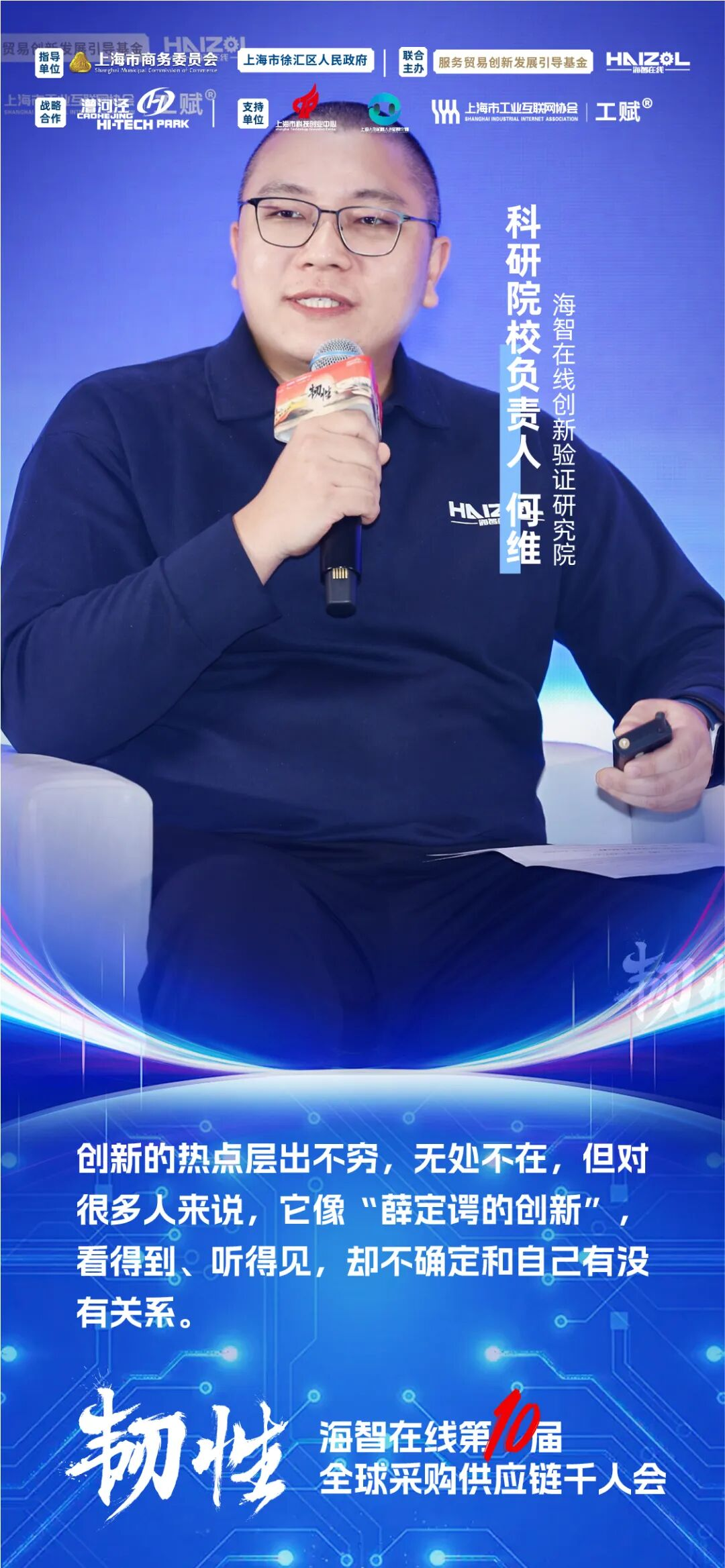
In conclusion, He Wei, Head of Research Institutions at the Haizhi Online Innovation Verification Research Institute, reflected that moving hard tech from laboratory to production is a voyage with both risks and rewards. Success, he noted, depends on a clear assessment of your own "vessel"—ensuring a robust technical foundation, thorough risk evaluation, and adequate safeguards. With the support of incubators, universities, manufacturers, and platforms, and provided preparations are sound, there is no need to be paralyzed by uncertainty. It is this courageous step forward that enables true "soft landings" for pioneering technologies onto the factory floor.
(He Wei, Head of Research Institutions at the Haizhi Online Innovation Verification Research Institute)
Roundtable 4Barriers, Boundaries, and Bridges: Reshaping the New Global Manufacturing LandscapeThis roundtable focused on how Chinese production capacity can break barriers, cross boundaries, and build new collaborative ecosystems within the global industrial landscape amid intensifying geopolitical games. Liu Haitao, Vice President of Haizhi Online, served as the moderator. Guests came from think tanks, central state-owned enterprises, banks, and overseas purchasers, discussing from four dimensions: macro trends, central SOE procurement, financial services, and cross-border collaboration.Liu Dian, Associate Researcher at the China Institute of Fudan University and Director of the Strategy and Macro Project at the Institute for AI International Governance of Tsinghua University, observed that despite escalating international competition in economics, trade, and technology, China's industrial system continues to expand. He affirmed that the deepening integration and symbiotic relationship between Chinese production capacity and global industrial chains represent a long-term, structural trend. He emphasized that in this phase of accelerating supply chain digitalization and intelligence, companies can no longer afford to be passive. They must proactively adapt to shifts in technology, markets, and labor division, strategically repositioning themselves to capitalize on new opportunities.
(Liu Dian, Associate Researcher at the China Institute of Fudan University
Director of the Strategy and Macro Project at the Institute for AI International Governance of Tsinghua University)Zhou Geng, Director of Procurement and Digitalization in a central state-owned enterprise in the oil and gas sector, shared the SOE perspective on import substitution. He revealed that while his company was once heavily reliant on imported offshore equipment, it is now systematically mapping out "chokepoint" components to create pathways for domestic substitution, allowing more local manufacturers to enter the core supply chain. He positioned central SOEs as both implementers of national strategy and vital gateways for small and medium-sized factories to access high-end markets. In this context, he noted, platforms like Haizhi can act as crucial bridges, connecting SOE demand with the specialized capabilities of SMEs.
(Zhou Geng, Director of Procurement and Digitalization in a central state-owned enterprise in the oil and gas sector)
Liang Yuhong, Deputy Head of Corporate Business at Shanghai Bank Caohejing Sub-branch, analyzed three types of risks faced by cross-border businesses in the current environment: rule differences and information asymmetry, low cross-border settlement efficiency, and exchange rate fluctuations. She mentioned that promoting the "go global" of manufacturing requires cross-border RMB, digital settlement tools, and a verifiable trade data foundation. She believes that if platforms like Haizhi, which integrate orders, logistics, and capital, can be leveraged, coupled with appropriate guarantees and risk control, it could enable more small and medium-sized factories to "see orders and also get funding."
(Liang Yuhong, Deputy Head of Corporate Business at Shanghai Bank Caohejing Sub-branch)
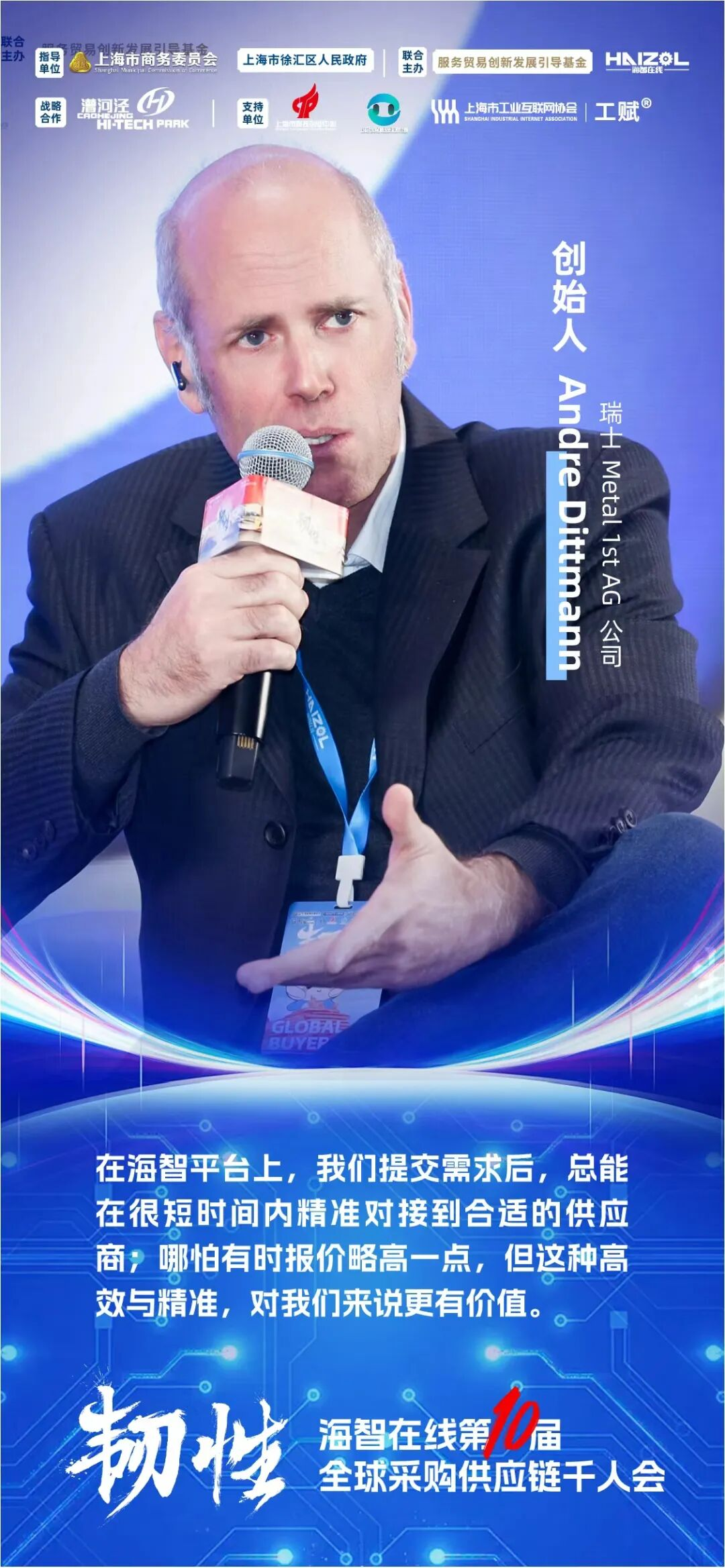
Andre Dittmann, Founder of Swiss Metal 1st AG, offered an overseas buyer's perspective, highlighting two distinct advantages of partnering with Chinese factories. First, he cited their exceptional responsiveness and execution, noting, "The proactive willingness of Chinese workers to work overtime to meet tight deadlines is something we rarely see in Europe." Second, he praised the efficient matchmaking capability of the Haizhi platform, which quickly connects him with qualified suppliers after he submits requirements. He concluded that even when Chinese quotes are not the absolute lowest, the combined value of "efficiency plus precision" often delivers a better overall experience than a focus on mere low price alone.
(Andre Dittmann, Founder of Swiss Metal 1st AG)
In summary, Liu Haitao, Vice President of Haizhi Online, stated that the global production and supply chain landscape is undergoing a profound transformation. While barriers and boundaries in this new reality may not vanish entirely, they can be redefined and bypassed by building new bridges. For all players—be they central SOEs, financial institutions, overseas buyers, or small and medium-sized factories—stability and new growth prospects amidst the turbulence will depend on their commitment to integration and symbiosis through joint innovation. Haizhi Online, he affirmed, will continue to connect more countries and diverse enterprises, empowering Chinese production capacity to assume a greater role in the future of global manufacturing.
(Liu Haitao, Vice President of Haizhi Online)
Signing CeremonyDuring the strategic partnership signing ceremony, Haizhi Online entered into cooperative agreements with Sanming Xinchuang Information Technology Co., Ltd., Wuhan Changmao Digital Industry Co., Ltd., SF Express Co., Ltd., and Yunhan Xincheng (Shanghai) Internet Technology Co., Ltd. These partnerships are focused on deep collaboration in several key areas: digital services for industrial component supply chains, integrated one-stop hosting solutions for non-standard parts coupled with digital sourcing tools, specialized logistics for the non-standard manufacturing sector, and joint mechatronics development offerings. By aligning with regional industrial platforms, state-owned enterprise groups, leading logistics providers, and electronics industry internet platforms, Haizhi Online will further streamline the critical "sourcing-transaction-logistics-service" pipeline. This integration aims to establish more efficient and resilient supply chain infrastructure for global purchasers and small-to-medium-sized factories alike.Overseas Buyers PresenceThe conference hosted its largest-ever delegation of overseas buyers, with nearly one hundred attendees representing over 20 countries and regions. Their procurement interests spanned nearly 30 sub-industries—including aerospace, automotive, medical, machinery, and electronics—and covered virtually all mainstream manufacturing processes. During the event, these international guests toured the product display and robotics exhibition zones and were formally introduced in an on-stage presentation. In the days following the main conference, the buyer delegation will travel to Suzhou and Hangzhou for dedicated matchmaking sessions. The itinerary also includes in-depth visits to manufacturing facilities in Shanghai, Suzhou, Hangzhou, and Ningbo, allowing them to evaluate the capabilities, efficiency, and potential of the Chinese supply chain firsthand, thereby accelerating the implementation of concrete cooperation.
(Partial overseas buyers taking the stage at the Haizhi Online 10th Thousand-Person Conference)
Awards CeremonyEach year, the Thousand-Person Conference includes an annual honors selection based on multi-dimensional platform data, with an awards ceremony held on-site to present trophies to winning enterprises. Over the past decade, Haizhi's development has relied on the joint participation and long-term trust of both supply and demand sides; it is these factories and buyers who continuously create value that collectively form the foundation and resilience of the Chinese supply chain. Through the annual selection, we aim to discover those who stand out and constantly break through in their respective fields, injecting continuous innovation momentum into Chinese manufacturing. In the future, Haizhi will continue to walk alongside all partners, promoting the Chinese supply chain to reach further in broader markets and more complex global landscapes.Panoramic Innovation Experience: Seeing Trends, Meeting Capacity, Promoting CooperationThe conference premiered a dedicated robotics exhibition zone, showcasing the latest forms of intelligent robots—including bipedal, quadrupedal, wheeled, and hybrid wheel-legged models—to present a systematic overview of the new-generation ecosystem in Chinese intelligent manufacturing. In the sample display area, nearly thirty high-quality factories from across the country brought their workshop capabilities directly to the venue, using real samples and critical components to let buyers and international visitors “assess competencies at a glance.” Beyond the formal agenda, the “Yunjin Princess” Huangpu River dinner cruise offered a relaxed and fluid environment for dialogue, enabling overseas buyers, domestic purchasers, and factory owners to engage deeply and explore new cooperation opportunities. Furthermore, this year’s Thousand-Person Conference adopted an upgraded “1+N” linkage format—delivering core content in Shanghai while organizing thematic matching sessions in Suzhou and Hangzhou—enabling collaborative innovation across multiple cities and scenarios.
(On-site photos of the Haizhi Online 10th Thousand-Person Conference)
Over the past decade, Haizhi Online has consistently adapted to industry shifts and feedback from both supply and demand, continuously enhancing the content and format of the Thousand-Person Conference. From trend foresight and scenario-based experiences to capacity showcases and cross-city integration, we have persistently developed more immersive and multi-dimensional settings to connect people, capabilities, and demand. Looking ahead, Haizhi Online will continue to bridge global markets through more open and dynamic channels—ensuring that outstanding Chinese factories gain the visibility they deserve, and that worldwide opportunities flow more swiftly and precisely to every corner of China’s manufacturing capacity.